
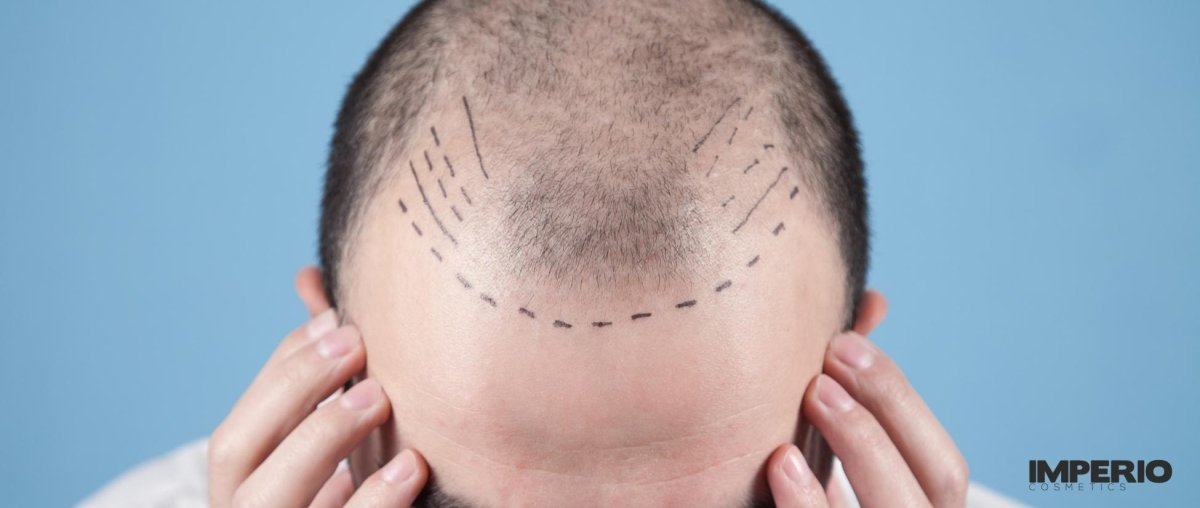
Your own hair is an important physical feature for many people. Hairstyles influence beauty ideals and can completely change the impression a person makes. Receding hairlines, bald patches, or even baldness are therefore often unwanted. They can even lead to severe psychological distress. One of the various options for taking targeted action against hair loss is hair transplantation.
But what exactly is hair transplantation? Who is it suitable for, and what do you need to consider? Here you will find all the important information about hair implantation.
What exactly is hair transplantation?
Hair transplantation, also known as hair grafting, is a surgical procedure. The doctor removes body hair and replants it in areas with little to no hair. This is therefore a kind of redistribution of hair. It is a frequently used method, especially for hair loss, to effectively and permanently address thinning areas. Hair transplants are available for women as well as for men.

The most important factor for a natural result is the hairline. The doctor does not simply replant the hair in large clumps or rows. He replicates the natural pattern in which hair grows as closely as possible.
For this reason, it is important that you research the different types of hair grafting thoroughly beforehand. Only then will you be truly satisfied with the final result.
Before having hair implanted, you should have a comprehensive consultation with a specialist. They can advise and inform you in the best possible way. Like any medical procedure, hair transplantation carries risks and side effects that you should consider beforehand. Furthermore, health insurance companies do not cover the costs of hair transplants, which is why the high cost is also a deciding factor.
TIP: You can choose from many different hair transplantation methods. They differ in their duration, applications, and price. The use of different techniques achieves more or less realistic results, respectively.
For those who think having hair implanted is a bit too much, there are good alternatives to cover thinning and sparse areas. There are several products that make your own hair look full again, such as hair fibers. They are easy to apply and significantly more affordable than hair grafting.
Read on to learn more details!
What requirements must be met for a hair transplant?
Are you interested in a hair transplant or would you like to learn the basics about the topic? Here you will find answers to all the important questions.
- The hair loss must be permanent. If it is caused by an illness or temporary medication use, the hair will eventually grow back. This is why visiting a doctor before hair grafting is essential to determine the cause of the hair loss.
- For an autologous hair transplant, all patients suffering from androgenetic alopecia (= hereditary hair loss) or hormonally caused hair loss are suitable. This includes women in menopause and men with a genetic predisposition to baldness. Cases of scarring hair loss caused by accidents, operations, or radiation are also suitable.
- There must also be enough healthy hair roots on the head that can be transplanted.
Where can I have hair transplanted?
Hair transplants are possible on the entire body.
- The doctor can fill in your scalp hair anywhere, depending on where the thinning area is located. This is often used to correct the hairline. A high forehead or receding hairlines can also be treated.
- Hair transplants are also possible on the top and back of the head, for example for a tonsure.
- On the face, you can fill in gaps in the beard and reconstruct eyebrows through transplantation.
- You can also make your hair growth denser and more even on the chest and in the intimate area.
Who performs hair transplants?
There are many clinics and doctors worldwide that offer hair thickening. However, you should carefully consider whether you want to have the procedure performed abroad. Low prices are often advertised for having hair transplanted in Turkey, for example. However, the risk of error is significantly higher. In Germany, you can find information about the treating doctor at the Medical Association.
An initial, non-binding consultation at a clinic or practice can be useful when choosing the treating doctor. You can read here what doctors say about hair transplants.
Does my age affect the result?
No, an autologous hair transplant can also be performed in younger years. However, the follow-up costs for the treatment will be significantly higher, because: hair loss is a lifelong process! Hair will continue to fall out, so follow-up treatment may be necessary. This can be done, for example, with medication.
One way to replace this follow-up treatment is the additional use of hair fibers. In the long term, this will even save you a lot of money! Because the cotton fibers bond with the (transplanted) natural hair, they create the impression of full, healthy hair. Hair fibers are applied with an applicator and sealed with a fixing spray so that they last all day. You can easily remove them when showering. They are well tolerated and easy to apply. This makes them an ideal transitional solution until the transplanted area has healed, as well as for concealing areas where hair loss continues to occur.
How much does a hair transplant cost?
Hair transplants are expensive procedures. Depending on the size of the area and the extent of the transplant, the costs vary greatly. As a rule, you should expect to pay several thousand euros. Since it is a purely cosmetic procedure with no medical necessity, health insurance companies do not cover the costs.
What happens during a hair transplant?
During every hair transplant, the doctor removes hair roots from the patient (under local anesthesia). He then replants them in a hairless area. The donor hair therefore comes from the patient himself. This is why it is often referred to as an autologous hair transplant.
The doctor transplants approximately 10-20 hairs per square centimeter of scalp. This value varies from patient to patient, as everyone has their own hair structure and therefore the natural hair growth must be addressed individually.

Approximately 500-2000 grafts (transplants) can be processed in one session.
For very large areas, it is therefore often necessary to perform the treatment in several sessions.
There are different methods for removing and replanting hair roots. They differ both in the procedure and in the results achieved. The treating doctor will inform you about this before the procedure, with whom you will first have an initial consultation. Afterwards, he will take a photo of the corresponding area and draw in the desired hairline. This allows you to see exactly what will happen on your head during the operation. The doctor will also inform you about the possible risks and side effects of the procedure.
Want to know more? Then definitely stay tuned!
FUT method
The FUT method is the most frequently performed hair transplantation method in Germany. The procedure takes between 3 and 9 hours and is usually possible within one session. A strip of skin is removed from the back of the head, on which healthy hair grows. Under a high-resolution microscope, the strip is then divided into so-called mini and micrografts. These are medium and smaller pieces of skin that contain approximately 1-4 (micrografts) or 4-8 (minigrafts) hair roots, depending on the size. Small holes are opened in the bald area, into which the grafts are then inserted.
One problem with the FUT method is the large scar at the back of the head. In some cases, it is up to 1 cm wide. Therefore, there must be sufficiently dense hair growth at this area to cover it. The scar also often causes a feeling of tension in the skin.
Since this method largely disregards the natural bundling of the hair, it is likely that the result will look unnatural or stamped.
FUT method (strip technique)
A further development of the FUT method is the so-called FUT method. Here, a strip of skin with hair is also removed and separated. However, it is not separated into mini and micrografts, but into follicular units (naturally growing hair bundles).
These FUs (from the English “follicular unit”) are then inserted into tiny channels in the skin with a fine needle. They heal on their own and do not need to be fixed.
The procedure takes approximately 2-8 hours depending on the size of the area and costs from €2500. After 2 weeks, the sutures at the strip area can be removed, and after 4 weeks, the transplants have healed.
In contrast to the FUT method, the result with the FUT is significantly more natural. Due to the relatively short healing time and the high engraftment rates, as well as the material-friendly approach, this procedure has already replaced the FUT method worldwide. FUT is also gaining ground in Germany.
FUE method
The most advanced hair transplantation technique is the FUE method.
Compared to the FUT and FUT methods, it completely avoids the removal of a strip of skin to keep scar formation as low as possible. Instead, individual follicular units are removed from the head. These consist of 1-5 hairs with roots. Since they are only about 0.5–1 mm in size, only microscars form, which are almost invisible to the eye. The removed grafts are prepared and inserted into the hairless area.
The FUE method is very labor-intensive and therefore only suitable for smaller areas. Because the result is very natural, it is often used to reconstruct hairlines, for example on the forehead.
In addition to the microscar formation, the advantage of the FUE method is that hairstyles with very short hair are possible, as no long scar has to be covered.
However, the disadvantage is the lower engraftment rate compared to the FUT method. Furthermore, a relatively large donor area is required. The doctor shaves this before the procedure. The actual transplantation is quite time-consuming and takes about 5–8 hours per session. The subsequent regeneration phase lasts 4 weeks, just like with the FUT method.
The FUE method is also the most expensive type of autologous hair transplantation and costs from €3,500 depending on the procedure.
Hair transplant performed—and now?
After the transplant, you need to pay attention to a few things, especially at the beginning. Depending on the type of procedure, the sutures are removed after about 2 weeks.
Here you will find all the important information about the aftercare and care of the transplant area.
What side effects does a hair transplant have?
This varies from person to person. In the short term, the following may occur:
- Itching
- Redness
- Pain
- Swelling
The treating doctor can prescribe individual antibiotics or painkillers for the initial period after the hair transplant.
Cooling the area can also help relieve pain and itching, but you should make sure that no moisture gets to the grafts.
How long does a hair transplant last?
A hair transplant is a permanent procedure. The transplanted hair roots grow into the scalp and then continuously produce new hair. Therefore, the result lasts a lifetime.
But: hair loss is a lifelong process. It is therefore entirely possible that more hair will fall out and your head will become thinner again. Then you should use additional products such as hair fibers.
What care products and shampoos can I use?
As long as there is scab on the scalp, you should completely avoid shampoo and care products. After that, you can use a mild, fragrance-free shampoo. Baby shampoo is not suitable.
Panthenol-containing wound healing sprays can support the healing of the area, but are not necessary. It is best to have your doctor advise you on any additional products.
How long is the transplant visible, and when does the hair grow?
It takes about 4 weeks for the area to heal. Until then, the scab and redness may give away the procedure. After that, it takes about 8-10 months for hair to grow in the transplanted areas and for the final result of the hair transplant to become visible.
When can I dye my hair again?
After the transplant, you should wait at least 4-6 weeks before dyeing or tinting your hair. Avoid drugstore dyes as much as possible so as not to damage the implanted roots too much. A professional hairdresser uses colors that are gentler on the hair and scalp and can also see the area better than you can in the bathroom mirror.
If possible, it is best to avoid dye altogether for 8-10 months. This will promote complete healing and healthy new hair growth as much as possible.
What else should I pay attention to after having hair implanted?
In the first few days, a scab forms in the areas where the grafts were transplanted. The area may become red or itchy.
You should leave the area in peace as much as possible. Scab formation and itching are normal accompanying symptoms of healing wounds. The scab protects the wound from bacteria and should under no circumstances be scratched off. It will fall off on its own once the skin underneath has healed.
Furthermore, it is important to keep the transplant area dry. This is why it makes sense to wear a shower patch when showering.
My hair is still falling out after the transplant! Is that normal?
This is completely normal and usually entirely harmless.
The operation temporarily interrupts the oxygen supply to the hair. This can cause more hair to fall out than usual at first. However, the hair roots remain intact and new hair will grow back. Until the bald patch has completely disappeared, you can also conceal it with hair fibers.
However, if excessive hair loss persists, you should consult a doctor.
What alternatives are there to hair transplantation?

Hair transplants are extensive, expensive procedures and are therefore not the right solution for everyone experiencing hair loss. Hair transplantation should not be performed, especially in cases of hair loss caused by illness or medication.
For this reason, it is important that you learn about possible alternatives.
Hair fibers
Hair fibers are the safest and easiest remedy for hair loss. They are loose cotton fibers (animal keratin was often used in the past). They attach to the remaining natural hair and conceal the scalp. This creates the appearance of naturally full, healthy hair. Hair fibers are very well tolerated and are also suitable for concealing the transition phase after a hair transplant and any remaining bald patches.
Medication
There are various active ingredients for treating hair loss. To find the right remedy, the cause of the hair loss must be known. You should definitely consult a doctor who can advise you and prescribe the right medication.
You can read about the different active ingredients here.
MHP (Microhair pigmentation)
Microhair pigmentation is a procedure in which color pigments are injected into the scalp. It is similar to permanent makeup. The advantage is that no surgery is performed, so no surgical scar is created. The color is long-lasting, but must be refreshed every 4–5 years (refresh appointment). 3–4 sessions are required, each lasting 1–3 hours. The healing time is 10 days.
PRP therapy (autologous blood treatment)
In PRP therapy, the doctor takes a few milliliters of the patient's own blood, which is centrifuged and then injected into the skin with a needle. This is intended to counteract hair loss. PRP is also used as an anti-aging solution against wrinkles. After a hair transplant, additional PRP therapy can increase the engraftment rate of the grafts. At least 3 sessions are required, each lasting about 30 minutes.