
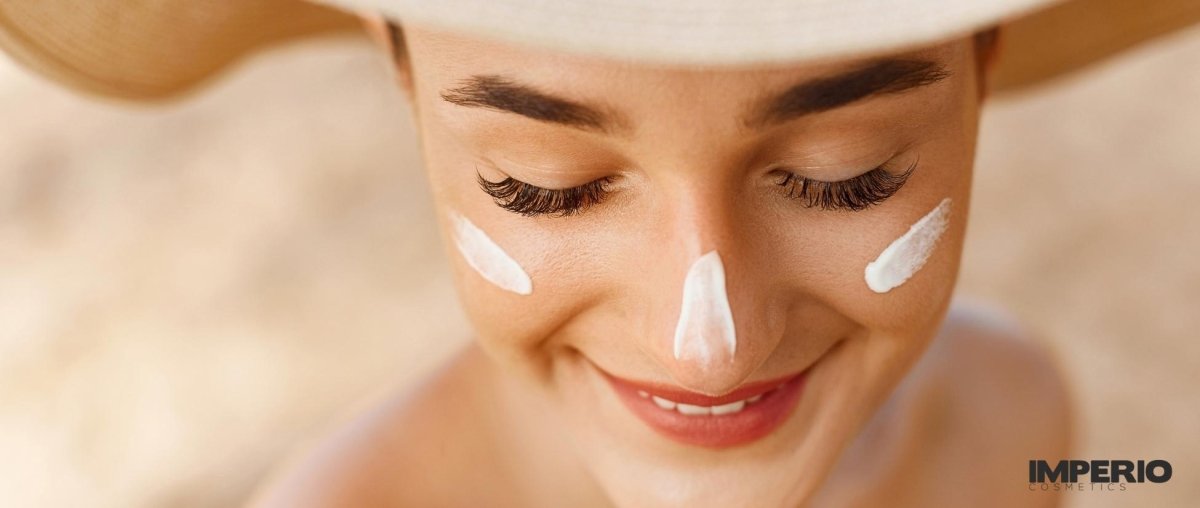
Summer, Sun, Sunburn
Relaxing on the beach, sitting on the terrace with a cool Hugo, letting your feet dangle in the cool water - summer time allows many of us to relax. This is not least due to the high temperatures, which take a toll on our bodies and keep us from strenuous physical activities.
We are all aware that we cannot enjoy this time all too carefree. Because the significantly increased sun exposure also brings risks such as sunburn. Why increased hair loss can occur in summer at all, we will explain in this post.
This is how our scalp is built

Our skin is our largest organ. It is basically built the same way all over the body. Depending on the body part, however, it differs in thickness and durability.
Due to our genetic predisposition, we are classified by the Federal Office for Radiation Protection into six different skin types. These skin types have very different levels of sensitivity to sun exposure.
While very light, almost transparent skin (Type 1) is prone to very quick sunburn, very dark skin (Type 6) can manage significantly longer without artificial sun protection.
But this does not mean that Type 4 does not burn. It will just take longer to set in than lighter skin types. Especially in the hot season, the risk of getting sunburn increases.
Our skin consists of three layers: the subcutaneous layer (subcutis), the leather layer (dermis), and the outer layer (epidermis). These skin layers are built with different thicknesses according to the skin types and our natural sun protection barrier is equally strong.
The Epidermis
... consists entirely of scaly cells, which are formed in the lower skin layers and with increasing age of the cells rise to the surface and there keratinize and loosen. In this way, our skin constantly renews itself. Depending on how dry the scalp is, the number of scales also varies.
The Dermis
..on the other hand consists of elastic fibers containing collagen. The resulting network gives our skin elasticity and a certain tensile strength. In the dermis are immune defense cells, our hair roots, nerves and skin glands, as well as lymph and blood vessels. If the dermis is weakened, e.g. by an unbalanced acid balance, elasticity is lost and hair roots can fall out faster.
The Subcutis
... connects the skin with the tissue underneath and consists mainly of connective and fatty tissue. The important epidermal stem cells are also located in it.
What sunburn on the scalp does

With our scalp, we first and foremost connect our head hair. But of course, it also takes on other important functions. On the one hand, the body temperature is regulated to a certain extent through it. In babies, for example, this is very important, because they have far fewer possibilities due to a lack of self-initiative.
The fat storage located in the subcutis also serves for thermal insulation and also provides energy to a small extent. This is just enough to sufficiently lubricate the scalp and supply the cells, hair roots and smooth muscle structures in the subcutis with energy.
The epidermal stem cells constantly build new cells, which mainly serves the regeneration of our skin. It also takes on other important functions. On the one hand, the body temperature is regulated to a certain extent through it.
In babies, for example, this is very important, because they have far fewer possibilities due to a lack of self-initiative.
If our scalp becomes too irritated or dries out, it can have major effects on our head hair. Irritated or overly dry scalp often cannot supply the hair roots with enough nutrients and does not have the necessary elasticity to hold them. Ultimately, this can lead to hair loss in summer.
Hair loss due to sunburn
In a sunburn, the individual skin layers are damaged down to the subcutis. UVA rays penetrate down to the subcutis and can, especially in very young sufferers, damage the epidermal stem cells.
In the event of damage to the epidermal stem cells, enough collagen can no longer be provided. This disrupts cell production and, moreover, superficial burns and the associated dehydration can lead to a disruption of the scalp's acid balance.

And this is exactly the problem: If the acid balance of the scalp is not right, hair loss often occurs. This can also be quite drastic after a sunburn. Although fallen-out hair grows back after appropriate regeneration and good scalp care, hair loss itself is an annoying matter.
Now it is a matter of finding a short-term solution with which you can get well through the summer.
There is one way that is now used by many people with naturally sparse or thin hair:
So that the scalp does not show through and an immediate result is achieved, many sufferers apply hair fibers to the finished styled hair and fix the loose powder made of cotton fibers with the help of hairspray. The hair then immediately looks thicker and more voluminous.
The best solution against hair loss in summer
To prevent sunburn-induced hair loss from occurring in the first place, the best method is to protect your scalp. Those who spend a lot of time in the sun should wear a head covering at best due to a lack of shady places.
This prevents sunburn perfectly and especially people with no or only sparse head hair can benefit from sunscreens with a high sun protection factor. Those who like to spend a lot of time outdoors should make sure to seek out enough shady places.

Drinking is also often forgotten, although the body's fluid balance is an important essence for the health of the cells and their renewal.
An adult should drink around 2.0 l of water per day. During the summer or during sports activities, the requirement for water intake increases to 2.5 to 3.0 l per day.
So those who drink enough, stay sufficiently in the shade and reapply sun protection to the skin at regular intervals can enjoy the summer time carefree. And without having to fear that the hair will become thinner in the hot season.