
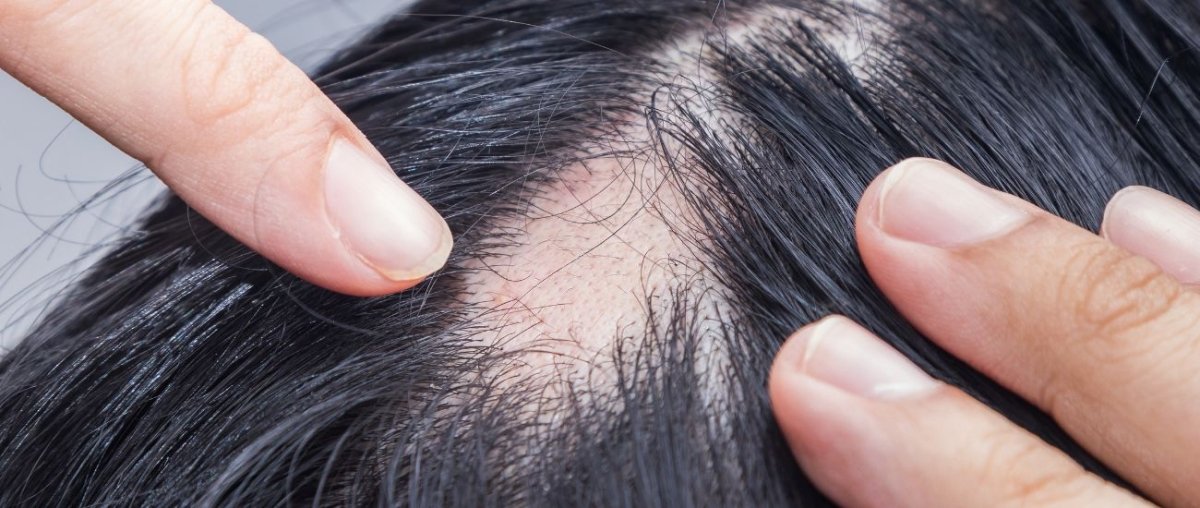
Patchy hair loss is a puzzle that continues to baffle scientists. Round, bald patches where not a single hair grows – researchers are still scratching their heads over the exact cause.
This article summarizes what is currently known about the possible triggers and how to deal with it.
Alopecia areata, as patchy hair loss is known in medical terms, affects women and men with equal probability. There is no link between gender and age. According to estimates, around 1.5 million people in Germany alone are affected by patchy hair loss.
Forms of patchy hair loss

Patchy hair loss most commonly affects the hair on the head. Occasionally, it also appears in other hairy areas, in men for example in the area of the beard (alopecia barbae).
Eyebrows, eyelashes and body hair, for example underarm and pubic hair, are also not safe from patchy hair loss.
Within a very short time, bald patches appear that are clearly defined and completely hairless.
Rarely, sufferers lose their entire head hair (alopecia totalis) or even their entire body hair (alopecia universalis). But such extreme cases are not common. So a small round patch does not necessarily indicate that the entire body will soon become bald!
Alopecia areata should not be confused with the very rare congenital hairlessness (alopecia congenita), in which the hair falls out completely shortly after birth and does not grow back on its own.
In the case of skin cancer in the scalp region treated with radiation, the hair follicles can be damaged. Then permanent hair loss occurs at the affected area. However, this is to be considered a side effect of the therapy and is not considered a typical course of patchy hair loss.
Does patchy hair loss indicate a disease?
As a rule, there are no other noticeable symptoms that would allow an inference about the cause of the hair loss. Patchy hair loss can affect anyone without warning. Whether seniors or teenagers, athletes, smokers, vegetarians or meat-eaters - the probability is equally high or low in all groups of people.
Some sufferers understandably get scared as soon as they discover bald patches on themselves and suspect a serious illness behind it. But in the vast majority of cases, alopecia areata does not indicate a disease.
The skin is sometimes doughy and thickened, but shows no external signs of inflammation.
If, on the other hand, the bald patches are red, inflamed and scaly, a fungal infection may be present. This should be treated by a dermatologist as quickly as possible so that the scalp does not scar. Otherwise, there is a risk that light patches will remain.
BY THE WAY: Trichotillomania, in which people compulsively pull out their own hair, or trichotemnomania – the overwhelming urge to cut off their hair in pieces – are sometimes confused with patchy hair loss. If clearly defined bald patches occur together with broken hairs or root inflammation, these causes should be considered.
The cause of patchy hair loss

The immune system makes a mistake by perceiving the hair follicles as a threat and ensuring that the hair falls out at the respective area.
This is demonstrable by a drastic increase of T-lymphocytes in the blood. These white blood cells are produced in greater quantities by the body when inflammatory foci need to be contained. Therefore, they are considered an indicator of inflammation, which in the case of patchy hair loss is to be sought at the hair follicles.
Why the body initiates this overreaction is not yet known. It is suspected that hereditary factors may play a role.
Some sufferers also report that patchy hair loss can worsen in stressful situations and under severe psychological stress.
Patients with autoimmune diseases such as vitiligo (white spot disease) or Hashimoto have a higher risk of developing alopecia areata. Patchy hair loss also occurs more frequently in people with Down syndrome.
Sometimes it appears as a concomitant symptom of chronic inflammation. These are noticeable, for example, more frequently in people who have a gluten intolerance (celiac disease). If they still consume gluten-rich food, this sets many inflammatory processes in motion in the body - mainly in the intestine, but the inflammation can also cause patchy hair loss.
From this it can be inferred that patchy hair loss can be due to an intolerance in some cases. Whether it concerns gluten, lactose, a specific active ingredient of a medication or hair care product must ultimately be determined by the dermatologist.
Apart from the mentioned "usual suspects", alopecia areata says nothing about the general state of health. Even perfectly healthy people can suddenly discover patchy hair loss on themselves without any apparent reason.
Alopecia Barbae - Patchy Hair Loss on the Beard
In men, it certainly happens that gaps in the beard are created by patchy hair loss, while the hair on the head shows no signs of hair loss at all. However, this is only a small comfort for sufferers, because bald patches in the beard are noticeable even when shaved.
Behind patchy hair loss on the beard is also an autoimmune reaction. The hair roots are attacked by the immune system as if they were pathogens, and simply fall out in clearly defined areas.
In alopecia barbae, the skin remains smooth and intact. If, on the other hand, it itches and scales, this indicates a fungal infection that can be very well treated by the dermatologist.
Reading tip: Concealing gaps in the beard - with a brilliant trick

Patchy Hair Loss During Pregnancy
Whether during or after pregnancy: Many young mothers have to endure alopecia areata. The exact reason, like with all other triggers, is still in the dark and is probably individually different for every affected woman.
It is suspected that the psychological and physical strain, iron or zinc deficiency, severe blood loss during birth or a hormonal imbalance in women could play a role.
The medically supervised intake of dietary supplements would be, accompanied by conscious mother-child relaxation rituals, a conceivable measure.
Patchy Hair Loss in Children

Boys and girls are affected by patchy hair loss with equal frequency.
Further signs that it is alopecia areata are noticeable changes in the fingernails: this can be a reddened nail moon, notches, spots, waves or rough sandpaper nails.
If the scalp is injured or visibly inflamed in the affected areas, a fungal infection is possible.
However, it also happens that children pull out their hair - often unnoticed by adults - compulsively. Then it is very important to proceed carefully and find out whether a psychological peculiarity, for example an aggression disorder or severe psychological stress, such as after a separation of the parents, could be behind it.
Reading tip: Hair loss in children
Patchy Hair Loss Due to Stress?
Although stress is not considered a direct trigger for patchy hair loss. However, many sufferers report that stress can greatly worsen the problem.
In addition, ongoing psychological strain can trigger oxidative processes in the body, promote inflammation and endanger the hormonal balance. We therefore cannot rule out that stress favors alopecia areata.
Reading tip: Hair loss due to stress
Is Alopecia Areata Related to the Thyroid?
In people who suffer from thyroid diseases such as Basedow's disease and Hashimoto's thyroiditis, patchy hair loss occurs statistically more frequently. That a connection can exist is therefore obvious.
Anyone who suspects a thyroid dysfunction in themselves can have this examined by a doctor through a blood test.
Reading tip: How hair loss & thyroid are connected
Symptoms of an underactive thyroid are a slowed metabolism, constipation, weight gain, fatigue, depressive moods, circulatory disorders and generally low blood pressure.
In contrast, a possible overactive thyroid is accompanied by heart palpitations, sleep disorders, thirst, restlessness, weight loss and high blood pressure.
Treatment & Symptom Therapy

Because the exact cause is not yet known, there are currently no effective cure methods. In most cases, the immune system eventually stops the attack on the hair follicles on its own and the hair grows back, without a therapy being necessary.
Whether and within what period a spontaneous healing takes place, however, varies from case to case.
Since patchy hair loss represents a psychological burden and can severely impair self-confidence, one can experiment with various symptom treatments.
Medical professionals can use tinctures or injections that irritate the scalp and are supposed to distract the immune system from the hair follicles in this way.
Also, corticosteroid-based ointments can be prescribed. Theoretically, it would also be a possibility to weaken the body's own defenses to the extent that they can no longer attack the hair.
These treatments are all controversial and do not lead to an actual cure. In addition, it is not recommended to use them in children, pregnant and breastfeeding women or sick and weakened people.
Vitamins Against Inflammation

Since patchy hair loss is accompanied by a clearly measurable inflammatory reaction in the body, the idea is close that anti-inflammatory preparations can counteract the hair loss.
Occasionally, patients have achieved good results with zinc preparations. Vitamin C also belongs to the natural anti-inflammatories and moreover strengthens the immune system.
A natural remedy known for thousands of years from Traditional Chinese Medicine (TCM), which has recently been back in everyone's mouth, are Adaptogens. These plant substances have the advantage that they are side-effect free and therefore can be consumed just as harmlessly by children as by pregnant women, seniors, sensitive or allergy-plagued people.
Primarily, medicine attributes a harmonizing effect of adaptogens to stress, depressive moods, intestinal problems and a weakened immune system. Therefore, it is conceivable that they can also provide relief in an autoimmune reaction.
Medical advice remains indispensable before taking any complementary preparations in any case!
Homeopathy Against Patchy Hair Loss?
Whether homeopathy works is known to be controversial. But especially in children, a gentle homeopathic treatment is probably preferable to a "shock therapy", in which the immune system is deliberately weakened!
After the motto: If it doesn't work, it can't hurt.
Corticosteroid injections have a higher risk of side effects in comparison.
Psychological Help Is As Important As Medical
Patchy hair loss causes distress that can have serious psychological consequences. The purchase of a wig is worth a thought. At the same time, psychological support or also participation in self-help groups can have an incredibly relieving effect.
Note: This article contains general information. It is not intended for self-diagnosis and also does not replace a doctor's visit!