
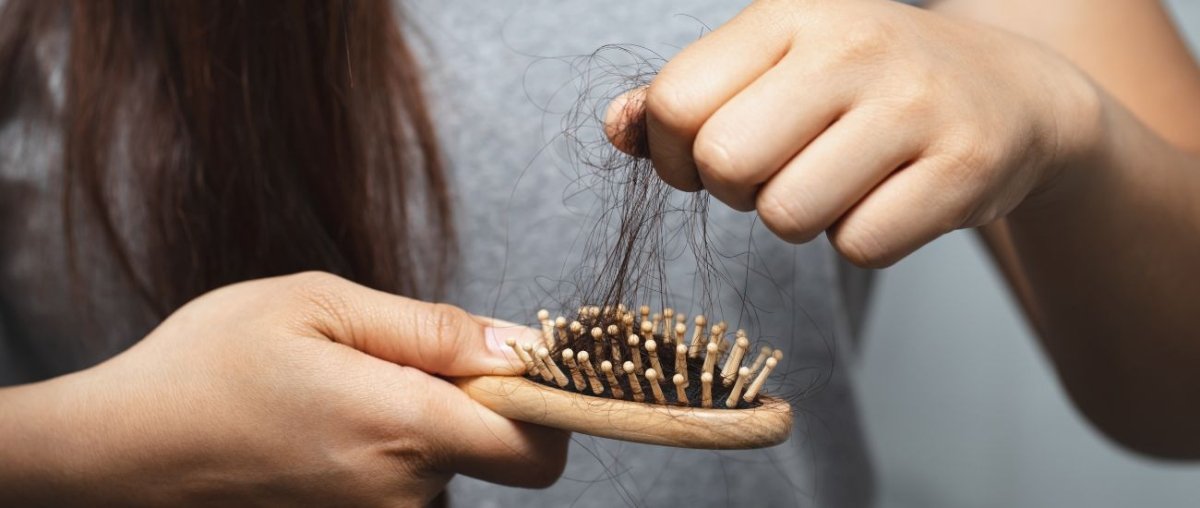
There is a lot of conflicting information about androgenetic alopecia, as hereditary hair loss is known in technical jargon. On the internet, experts and those who appoint themselves as such discuss whether hereditary hair loss is now curable or not.
The fact is: androgenetic alopecia is not a disease, but a purely aesthetic problem! Furthermore, there is a consensus that the course of hair loss varies individually among all those affected. Whether man or woman, young or old - according to genetic predisposition, hereditary hair loss can set in at any time and spread to varying degrees.
Although there are some general measures with which everyone can delay hereditary hair loss. But even a healthy diet, sports, head massages and rich hair care cannot completely prevent hair loss in the long term. Nevertheless, androgenetic alopecia is not a problem that you have to accept. Because there are indeed means that can bring back hair density. As always, knowledge is power!
How do you recognize hereditary hair loss? What differences are there between the sexes? And finally, the most important question – what really helps against it?
The cause of hereditary hair loss
Hereditary hair loss is caused by so-called androgens (male sex hormones). The main culprit is called dihydrotestosterone (DHT). A highly active form of testosterone.
This hormone is mainly responsible for the development of male sex characteristics. Men need DHT, for example, for normal prostate function, potency and fertility. In puberty, it ensures that the shoulders get broader, the voice deeper and body hair thicker.
In the female organism, DHT plays a less important role and is present in a much lower concentration. However, its effect should not be underestimated, because it is essential for sebum production on the scalp, libido and the development of male embryos during pregnancy.
BY THE WAY: Alopecia is the technical term for visibly thinner hair. Dermatologists refer to the hair loss itself as effluvium. Therefore, in connection with hereditary hair loss, you will also come across the term "androgenetic effluvium".
How can DHT cause hair loss?
Dihydrotestosterone influences our hair growth, among other things, by acting on hormone receptors on the hair follicles. Some people have an above-average number of receptors that react to DHT. This makes the hair follicles more sensitive. With continuous contact with DHT, they are damaged.
The attacked hair roots shrink and produce thinner and thinner hair, which also falls out earlier.
At a certain stage, the hair roots can no longer form hair at all and the hair loss remains irreversible, i.e., irreversible.
Even the best hair growth products cannot change this process, because they cannot address the actual cause of hereditary hair loss: a hormonal hypersensitivity. The predisposition to this DHT sensitivity is innate and can be passed on to offspring.
In people who do not have this predisposition, dihydrotestosterone also has no negative effect on hair growth.
Hereditary hair loss in men

Men are affected by androgenetic alopecia much more frequently than women because they have a much higher concentration of androgens in their bodies.
In some, hereditary hair loss sets in as early as young adulthood, while others only notice it in the second half of life. When androgenetic alopecia begins is mainly determined by genetic makeup.
How severe the hair loss is and how far it spreads depends on how pronounced the DHT sensitivity is. If the hair follicles have a lot of receptors, the hormone can act much more intensely. Then it doesn't take long until the hair root gives up.
If there are fewer receptors, the deterioration process progresses more slowly and the affected man has a good chance of keeping his hair until old age.
This course is typical for hereditary hair loss: First, receding hairlines in men appear. The hairline above the temples recedes further and further. At the back of the head, the hair usually thins out in a circular pattern and the thinning areas approach each other until a forehead bald spot is formed. The hair ring in the neck area remains until the very end, because the hair follicles in the neck are more DHT-insensitive.
Hereditary hair loss in women

Women who are prone to hereditary hair loss often only notice it during menopause: When estrogen levels drop, there is no balance to the androgens and the hair follicles are left at the mercy of the sudden dominance of dihydrotestosterone.
This can also manifest in women without a hereditary predisposition through sudden diffuse hair loss during menopause.
Some women already suffer from androgenetic alopecia in their 20s or 30s. An elevated testosterone level or simply a very unfavorable predisposition may be to blame!
In most cases, hereditary hair loss follows the feminine pattern: The hair gradually thins out on top of the head because the DHT-sensitive hair follicles are distributed along the parting.
However, receding hairlines in women can also occur, which recedes towards the top of the head. In this case, it is referred to as the masculine type.
Medications for hereditary hair loss
Medications against hair loss usually aim to prevent the conversion of testosterone into dihydrotestosterone. However, it can take months until the effect becomes visually noticeable and it only lasts as long as you take the medication regularly.
Finasteride
Men between the ages of 18 and 40 are often recommended finasteride, a prescription medication in tablet form that is not suitable for women. Finasteride is said to be particularly effective and can even make shrunken hair grow back. Considering that possible side effects, such as potency disorders, breast enlargement and prostate malformations can be permanent according to medical experts, instead of disappearing with the discontinuation of the medication, this is however a deterrent for many.
Minoxidil
Minoxidil is an over-the-counter foam that is applied directly to the scalp. Women can use minoxidil just like men, although they should use a lower concentration of the active ingredient. Because in women there is the additional risk that hair growth spreads unwantedly to the face. That minoxidil stimulates hair growth was discovered by researchers by chance. Exactly why it shows this effect is not yet clear.
Alfatradiol
Alfatradiol is a lesser-known remedy for hair loss that, similar to minoxidil, is applied directly to the affected areas. It is supposed to prevent dihydrotestosterone from coming into contact with the hair root. The list of possible side effects is manageable, but the efficacy is considered low.
If the doctor determines that hair loss in women is caused by an elevated testosterone level, hormone treatment with antiandrogens may be considered. These partially counteract the effects of male sex hormones.
NOTE: The use of the mentioned active ingredients only makes sense if it is actually hereditary hair loss. They do nothing against diffuse or circular hair loss. Pregnant and breastfeeding women should generally avoid taking hormone-active preparations, as they pose an unacceptable risk to the baby.
Hair transplantation for hereditary hair loss?

In a hair transplant, own hair is removed from the neck area and replanted in the areas to be concealed. Ideally, the transplanted hair continues to grow normally and is no longer a victim of androgenetic alopecia.
Finally, the hair follicles in the neck area are insensitive to DHT. However, lasting success cannot be guaranteed.
Depending on how large the area affected by hair loss is, a hair transplant can be a significant cost factor. You should budget at least 4000 euros.
Scalp Painting | Scalp Pigmentation | Micro Hair Pigmentation
In scalp painting, also known as scalp pigmentation or micro hair pigmentation here, tiny color pigments are inserted into the scalp at intervals.
The method resembles a tattoo and is particularly suitable for bald heads, bald spots and receding hairlines where no own hair grows anymore. Scalp painting creates the illusion of closely packed, short hair stubble in the affected areas of the scalp.
Own hair transplants can be supplemented with micro hair pigmentation to achieve an even more authentic result with more visual density.
But even bald heads who naturally have dark hair and in whom the course of androgenetic alopecia is still visible despite the shortness often achieve good results with scalp pigmentation.
Advantageous hairstyles for hereditary hair loss
Dare to go bald

Anyone who takes a close look around the street will find that a bald head in men is not an all-too-rare hairstyle. Far more than half of all men struggle with hereditary hair loss, because with increasing age, the number of people visibly affected by androgenetic alopecia also increases.
That is why it is obvious to many to choose a very short hairstyle – because it conceals hair loss best.
Studies show that we trust bald men with better leadership qualities, more intelligence and assertiveness, and also perceive them as more attractive than those who comb their thinning hair with their last desperation over the half-baldness.
Letting the hair on the back of the head or the remaining hair ring in the neck grow long involuntarily draws the eye to the bald spots.
This makes men look older and less groomed than they really are. A bald head or very short hairstyle, on the other hand, highlights the advantages of the facial features.
An unsuitable head shape or chin can be compensated for by a man with a beard. The length of the beard is not the deciding factor, it is only important that it looks groomed.
Short, dense, voluminous

To conceal receding hairlines when the top hair is still full and dense, a side fringe or side part is suitable. Simply part the hair on the preferred side and comb it with a natural swing over a receding hairline.
If only one receding hairline is visible, while the main hair covers the flaw on the other half of the face, we do not perceive it as a sign of thinning hair, but as a masculine thinker's forehead.
With slight hair loss, you can also use a fade cut. This is a style cut with very short neck hair that gradually gains length towards the top and transitions into voluminous top hair, which automatically looks fuller due to the contrast with the neck.
For women: With short or medium-length hairstyles, volume can be easily created even with thin hair. The top hair should always remain as full as possible. The thinning scissors have no place here.
Hairstyles with a top knot, combed back or with a slightly offset side part cover a thinning top area. Dark hair colors and highlights give the hairstyle even more visual density.
Hair thickening and extensions are affordable depending on the amount and effort and are available at almost every hairdresser.
Note: This article contains general information. It is not intended for self-diagnosis and does not replace a doctor's visit!